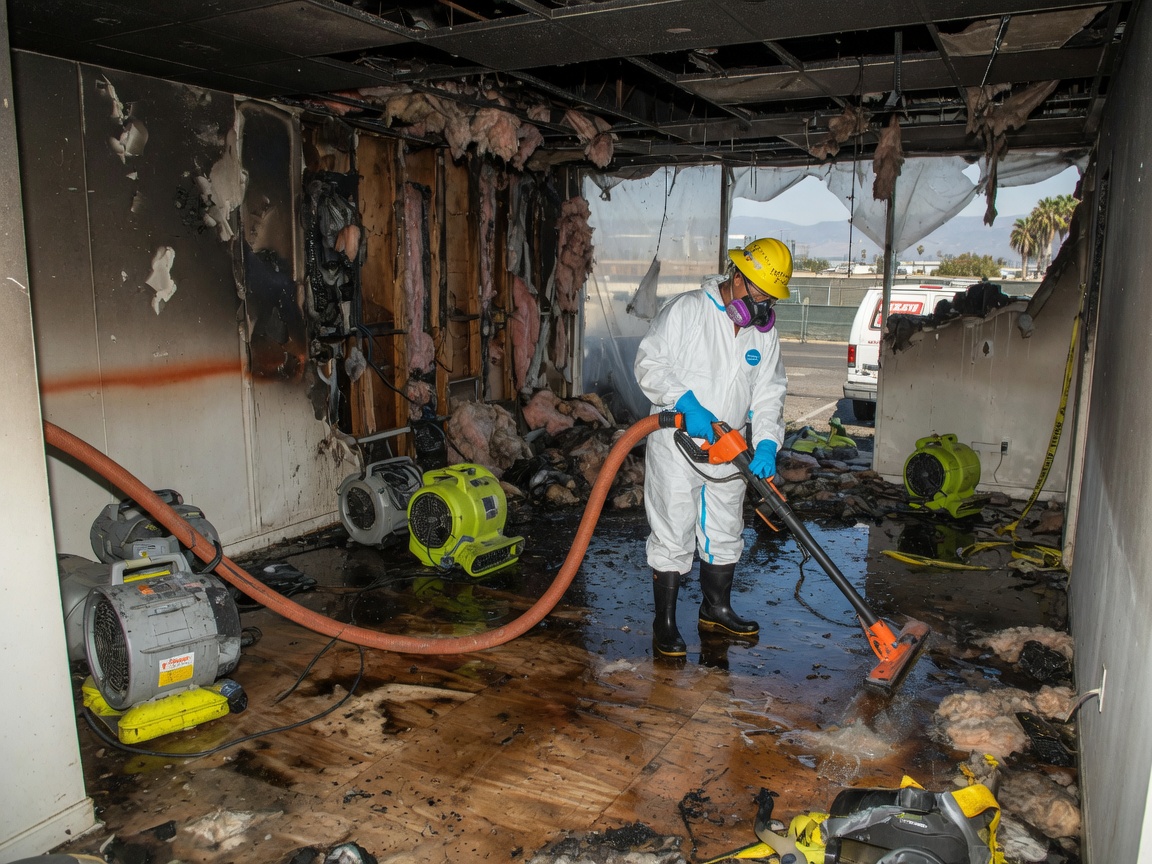
Firefighting efforts in Guasti often leave standing water that saturates drywall, subfloors, and insulation in the area's mix of mid-century stucco homes and converted warehouse spaces near the airport. Hidden moisture behind walls can feed mold within 48 hours when daytime heat spikes, so crews must open cavities early and use moisture meters on every surface rather than relying on visible signs alone.
Smoke residue from wildfires carried by Santa Ana winds frequently mixes with water to create acidic compounds that etch metal fixtures and corrode electrical boxes in older properties along Turner Avenue and nearby logistics corridors. Technicians test pH levels on affected surfaces and neutralize before drying begins, because untreated residue reappears as staining once humidity drops in the dry regional climate.
Disposal of fire-soaked debris must follow San Bernardino County rules for contaminated materials, which means separating charred drywall from regular construction waste at the job site. Homeowners who skip this step risk fines when loads reach local transfer stations, and crews document every load to keep the project compliant without delaying the drying timeline.
Technician insight
In Guasti the thing that catches most people out with water damage remediation after fire is how quickly moisture evaporates from the surface while staying trapped inside stucco walls and under the slab near the old winery district, so you have to keep meters on the job for days longer than homeowners expect.
Warehouse Loft on Turner Avenue
Firefighting water pooled under a converted warehouse floor after a small electrical fire. Crews found hidden saturation in the subfloor joists running toward the alley. Extraction and targeted drying prevented mold growth before the next heat wave, allowing the owner to resume operations without tearing out the entire floor.
Water Damage Remediation After Fire Services We Offer
✓Firefighting Water Extraction
Rapid removal of standing water from hoses and sprinklers using truck-mounted pumps sized for Guasti's commercial and residential slabs.
✓Soot and Residue Cleaning
HEPA vacuuming and pH-neutral washing of walls, ceilings, and contents to prevent smoke particles from bonding during the drying phase.
✓Structural Drying After Fire
Placement of air movers and dehumidifiers calibrated for the low-humidity conditions typical in the Guasti area to pull moisture from framing and subfloors.
✓HVAC Smoke Decontamination
Inspection and cleaning of ductwork that can carry soot throughout homes near the 10 freeway corridor after regional fire events.
✓Odor Neutralization Treatment
Application of thermal fogging and hydroxyl generators to break down smoke odors trapped in porous materials common in older Guasti properties.
How it works
- 1
Site Assessment
Technicians arrive within hours, map water migration paths through Guasti's typical slab-on-grade construction, and identify smoke-affected zones.
- 2
Water Removal
Standing water is extracted first, followed by removal of saturated insulation and drywall to prevent secondary damage in dry regional air.
- 3
Drying and Monitoring
Equipment is staged and moisture readings are logged daily until levels match unaffected areas in the same neighborhood.
- 4
Final Cleaning and Clearance
Surfaces are cleaned, odors are treated, and the site is cleared for reconstruction once independent verification confirms safe conditions.
Pricing
Cost depends on square footage affected, number of rooms opened, and whether HVAC cleaning is required; upfront quotes provided after inspection.